First order
10% off your first order
Use code FIRSTORDER at checkout. One per customer, and it works on sale items too.
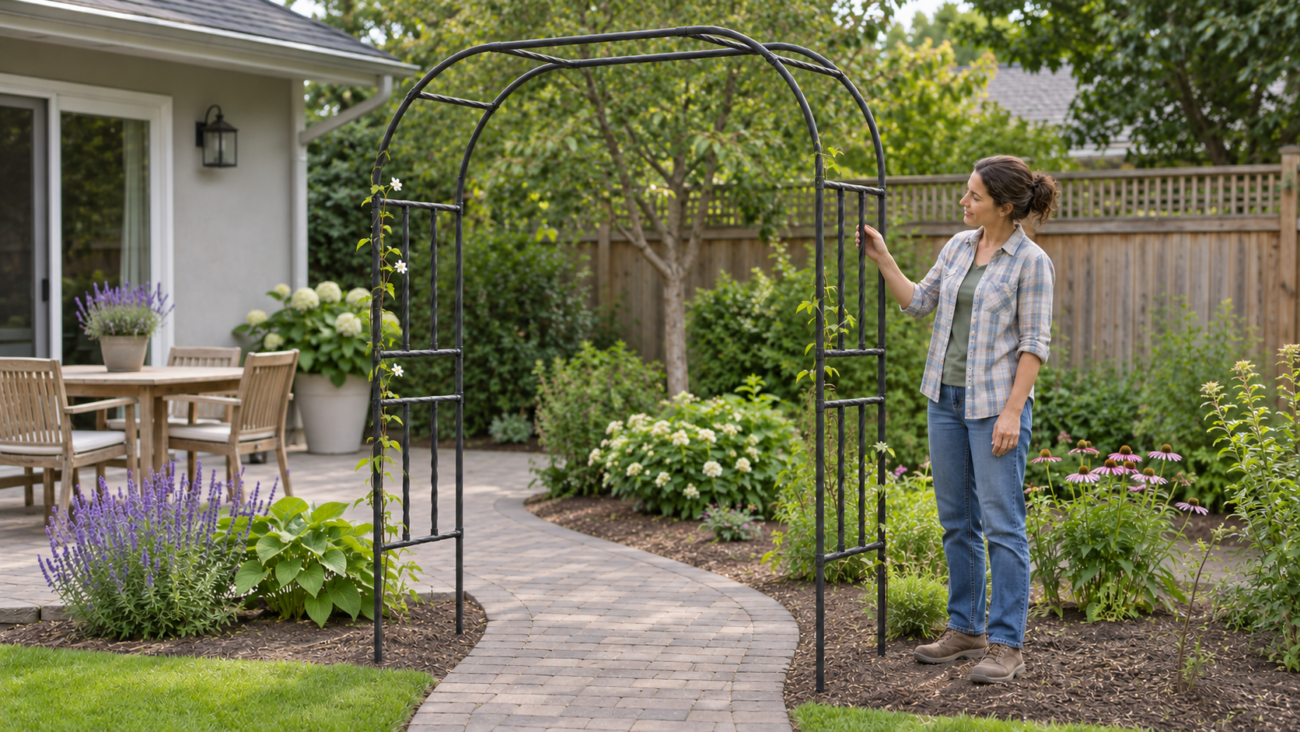
To keep a garden arch standing in wind, secure every support using a method specified for the model and your ground surface. On soil, that may mean inserting the legs to the required depth or using compatible ground anchors. On a patio, it may mean an approved weighted-base system or a designed connection to a suitable structural surface. Tight connections and sound ground matter as much as the frame itself.
There is no universal stake length or number of pounds that makes every arch wind-resistant. The right arrangement depends on the arch, exposure, ground conditions, and plant coverage. Start by identifying what needs securing, then choose the appropriate installation route below.
Key takeaways
– A rigid frame still needs an effective connection to the ground or base.
– Soil, concrete, paving blocks, and wood decks require different installation decisions.
– Plants and decorations change the demands on an arch after installation.
– Extra stakes or loose weights are useful only when they form part of a compatible fixing system.
– Recheck the installation after strong wind, heavy rain, and substantial changes in plant growth.
A garden arch can move in several places. The frame may flex, a joint may loosen, a leg may shift in the soil, or a base may slide or lift. Adding weight to the feet will not repair a loose connection higher up the frame.
Plant growth also changes the installation. New Mexico State University Extension identifies both canopy and wind loads as considerations in vineyard trellis design. The same general lesson matters when planning an arch: assess the support with its intended planting, rather than judging it only as an empty frame. Vineyard construction dimensions are not specifications for a garden arch. [Source: NMSU Extension]
In calm conditions, inspect where movement is occurring before deciding on a repair. Keep a leaning or damaged arch out of use while you resolve the problem.
| What you notice | What to inspect | What it may require |
| A joint opens or shifts | Missing, loose, damaged, or incorrectly assembled connectors | Correct assembly or manufacturer-approved replacement parts |
| A leg rocks in an enlarged hole | Reinstallation or an approved alternative fixing method | |
| The entire base moves | Base-to-frame connection, surface condition, and base specification | A compatible base system or a different installation arrangement |
| One side gradually sinks | Uneven or disturbed ground beneath the supports | Ground assessment and correction before reinstallation |
| The frame stays bent after the wind stops | Tubes, welds, joints, and attachment points | Assessment and repair or replacement, rather than simply more anchors |
A light hand check can reveal obvious looseness, but it does not establish a wind rating. Do not try to prove stability by climbing, hanging from, or forcefully pulling the arch.
Soil installation works only when the specified supports can engage suitable ground. Loose potting mix, a recently dug bed, saturated soil, and established garden soil should not be assumed to provide the same holding conditions.
University of Minnesota Extension advises securing garden trellis stakes deeply enough to avoid tipping in strong wind, but it does not provide a universal insertion depth for every structure. Use your arch’s requirements for the actual installation.[Source: UMN Extension]
Mark the intended leg positions and confirm that the walkway, gate swing, and nearby beds remain usable. Inspect the ground for signs of erosion or recent disturbance.
Before driving legs, stakes, or anchors into the ground, contact your state’s 811 service and follow its process. Note that 811 typically only marks public utility lines (municipal water, gas, main power). They do not mark private lines on your property, such as automatic sprinkler systems, landscape lighting wires, or private septic lines.So these still need to be checked manually before mining. [Source: Texas811]
If rocks, roots, or buried services prevent the required installation, choose another location or seek a suitable alternative. A partly inserted leg is not equivalent to the specified fixing.
Follow the model’s assembly sequence, use the supplied components as directed, and keep the frame aligned as you position it. Tighten connectors according to the instructions; excessive tightening can damage some components.
For example, the OnlyGarden Square Tube Garden Arch Trellis product page specifies 11.8 inches of ground insertion. That is a model-specific instruction, not a depth to apply to every garden arch or a promise of performance in any wind or soil.
Preserve the required insertion when checking headroom. If installation leaves too little clearance, reconsider the size or location rather than leaving the legs shallow. Our garden arch size and clearance guide explains which measurements to confirm.
If the manufacturer permits additional ground anchors, check the complete arrangement: the anchor type, suitable soil, attachment point, connector, and positioning. A stake beside a leg does not secure the arch unless the connection between them is appropriate.
Avoid drilling extra holes in thin tubing, driving improvised rebar inside the legs, or attaching guy lines to decorative bars without approval. Such changes may damage the frame or put force into a component that was not designed to take it.
Keep permitted anchors and lines clear of walking routes, lawn equipment, and areas used by children or pets. If the only workable arrangement obstructs the path, reconsider the location.
Inspect the leg positions after substantial rain and after windy weather. Look for widened holes, settlement, exposed sections, or a frame that no longer stands square.
Repeated rocking needs a change in the installation or site conditions. Adding loose soil around a moving leg may hide the gap without resolving why it is moving.
First identify what the patio actually consists of. A concrete slab, separate pavers over bedding material, and a wood or composite deck are different supports. An installation method suited to one cannot automatically be transferred to another.
A weighted base needs to connect securely to the arch and suit the installation conditions. Weight placed nearby contributes nothing if the frame can separate from it.
For patio installation, check whether your exact arch model has a documented weighted-base option. Confirm the compatible base, leg connection, required ballast, and permitted installation conditions before purchasing accessories.
Check that:
– Every required support has the specified base and connection.
– The surface is suitable for the system, including any slope or unevenness.
– The bases leave doors, gates, drainage, and walking space clear.
– The supplier has addressed the intended arch size and plant coverage.
A decorative planter, loose sandbag, or paving slab is not automatically an approved base. A planter installation needs a defined connection and specified contents; its appearance or apparent heaviness does not establish adequacy.
Bolting is an option only if the arch has suitable mounting provisions and the supporting concrete can accept the specified anchors.
The required hardware depends on the bracket, anchor system, concrete condition, slab thickness, edge distances, and loads. Drilling into a surface without knowing what is below it can also damage embedded services or other concealed features.
For permanent installation, ask the manufacturer for a mounting detail and have a qualified installer assess the slab where necessary. Follow the selected anchor manufacturer’s instructions. Generic bolt sizes or hole depths cannot establish a suitable connection for an unspecified arch and slab.
With individual pavers, fixing to the visible surface may leave the arch connected only to a movable block. Establish what will resist movement beneath the finished paving. A suitable solution may require an approved base or a designed footing arrangement.
On a deck, do not assume that screws through the surface boards provide an adequate structural attachment. Connections need assessment of the supporting framing, hardware, and any waterproofing. A contractor can determine whether the proposed installation is suitable. A generic deck connection guide does not constitute an arch mounting design.
If your model has no approved hard-surface arrangement, changing the location or choosing a model with documented support options is more useful than improvising a mounting bracket.
Review what the arch carries as it develops. Keep trained stems supported, maintain the intended passage, and inspect connections that foliage may conceal. Prune according to the plant’s needs; avoid severe cutting solely to compensate for an unsuitable frame or fixing system.
Drapes, banners, shade fabric, and hanging decorations can change how the structure catches wind. Before forecast windy weather, remove detachable decorations where it is safe to do so and follow the manufacturer’s instructions for temporary installations.
Do preparation while conditions are calm. The National Weather Service advises securing loose outdoor objects and taking shelter during dangerous winds. Do not stand beneath a moving arch or attempt repairs during a storm. [Source: National Weather Service]
Afterward, check alignment, connections, legs, and bases before reopening the route. Assess permanent bending or damaged joints before reusing the structure.
Use the insertion depth specified for your exact model, and mark it on each leg before installation. Insert all legs evenly to that depth; do not stop short to gain height. If the soil cannot hold them firmly, confirm a compatible anchoring method rather than assuming deeper insertion will solve the problem.
Check the leg holes for washout, softened soil, or uneven settlement, and inspect the frame joints separately. Restore the specified installation only where the ground can hold it. If rocking returns, relocate the arch or obtain a compatible anchoring arrangement rather than repeatedly packing loose soil around the legs.
No. Frame weight does not establish how securely an arch is attached to the ground. The leg installation, base connections, ground conditions, and plant coverage still matter. Follow the fixing requirements for your model and ask about site suitability if the position is exposed.
Take down detachable drapes, banners, and similar decorations while conditions are calm; they add surfaces for wind to catch. Follow the model’s instructions for any other removable attachments. If strong winds have already started, stay clear of a moving arch rather than attempting to dismantle or steady it.
A garden arch stays useful when its frame, connectors, supports, and ground work together. Identify the surface, follow the model-specific fixing method, and revisit the installation as plants and ground conditions change.
Before installing in an exposed position, ask OnlyGarden to confirm the fixing arrangement for your model, surface, and intended planting.
Popular categories

